This project is a haptic mouse designed for visually impaired users, enabling more accessible computer interaction and helping ensure users are not left behind as technology continues to evolve.
The mouse features a unique dual-shell architecture that separates interaction and sensing systems for improved performance and reliability.
The outer shell houses nine high-strength vibration motors distributed throughout the body of the mouse, along with a custom PCB responsible for user interaction features such as left click, right click, and the scroll wheel. This PCB also includes dedicated motor drivers for each vibration motor, with communication handled via the I²C interface.
Between the outer and inner shells, an elastic isolation layer will be used to mechanically connect the two structures while absorbing the majority of the vibration generated by the motors. This helps prevent unwanted interference with the mouse’s sensitive tracking components and ensures consistent sensor performance.
Research and testing are still underway to identify the optimal material that provides the best balance of vibration damping, durability, and manufacturability.
The inner shell contains all sensitive tracking and processing components on a separate custom PCB. These include the PAW3395 optical mouse sensor (communicating over SPI), an RP2040 microcontroller, and all power-management circuitry.
The inner system connects to a small front-mounted board that contains only a USB-C port. The mouse is intentionally wired to reduce system complexity, eliminate wireless communication overhead, and save weight by avoiding the need for a battery.
Each circuit board is currently being tested in isolated development phases to identify and resolve issues independently. Once all subsystems function reliably, they will be integrated into the final unified circuitry.
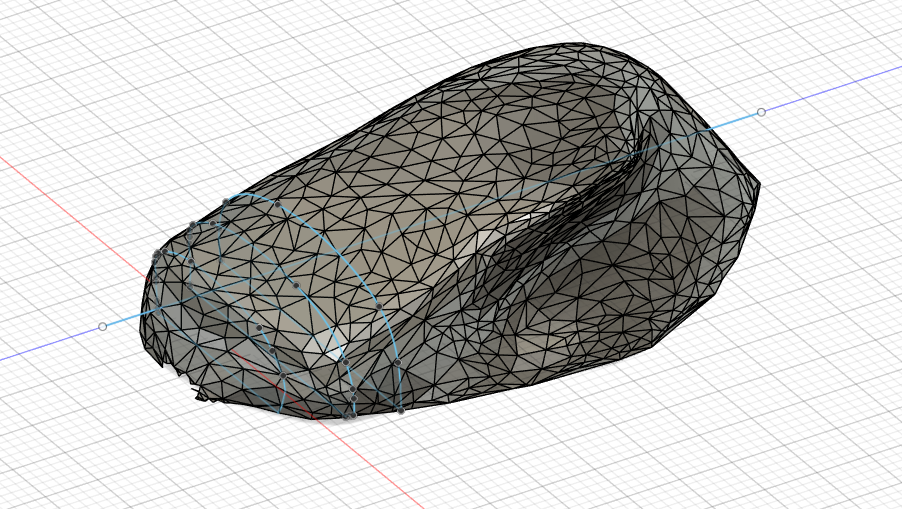
The mechanical design of the mouse is loosely based on the Logitech MX Master due to its well-regarded ergonomics. Development began with a clay prototype modeled from reference images, which was then scanned using photogrammetry.
After cleanup, the scan was imported into Fusion 360 and converted into a B-rep model. The mouse body was sliced into cross-sections, and new geometry was reconstructed between these sections, allowing for a more customized and comfortable shape while providing the flexibility needed to accommodate internal electronics.
The shell will ultimately be 3d printed likely out of PLA.
The software side of the project has not yet been fully developed, but planned features include user-adjustable vibration intensity and dynamic haptic feedback that responds to active elements on the screen.
This mouse is intended to be used alongside screen-reader and read-aloud software, providing users with a richer and more intuitive understanding of the digital environment through both audio and haptic feedback.